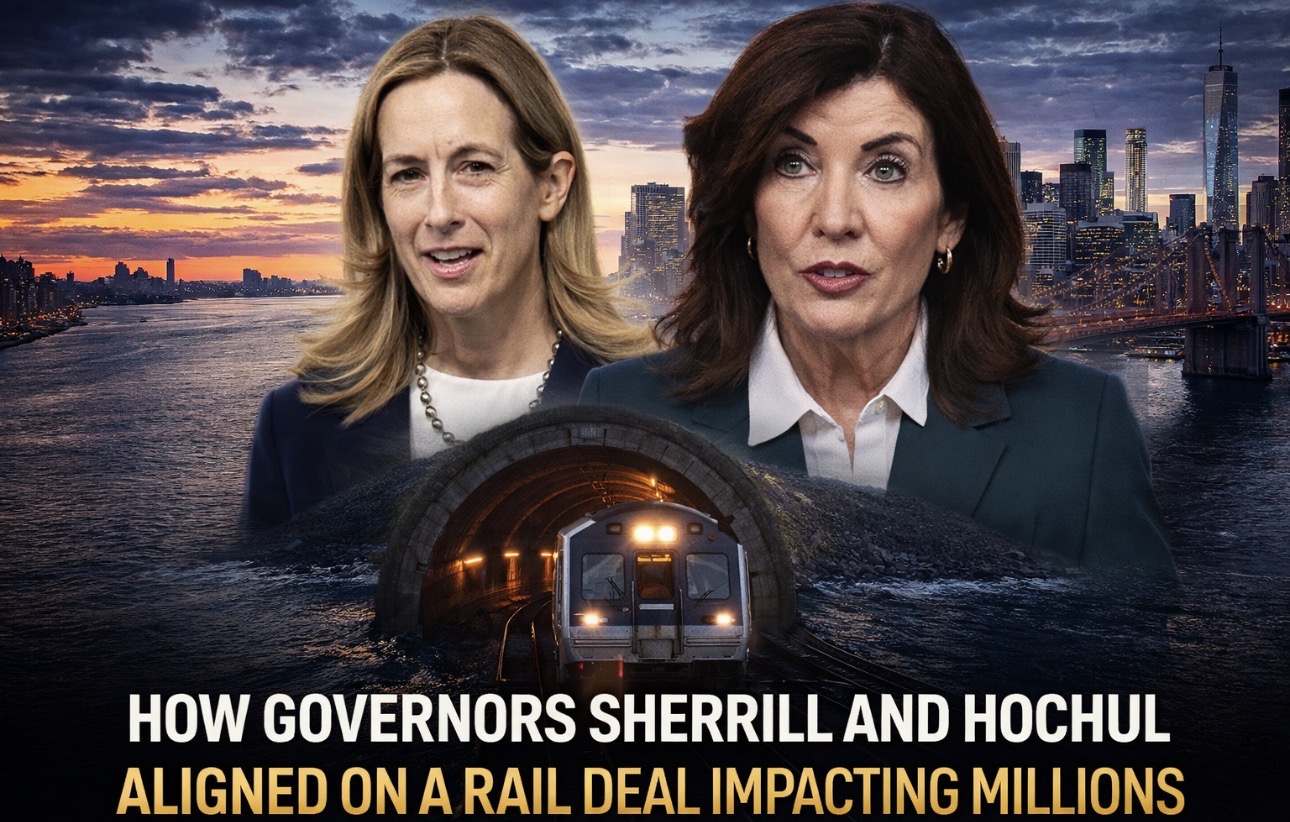
Recently, New Jersey Governor Mikie Sherrill and New York Governor Kathy Hochul reached a coordinated political understanding that could finally move forward the long-stalled Gateway rail tunnel project. While no single public agreement was announced, the alignment reflects a shared strategy between the two governors on leadership, legal posture, and inter-state cooperation surrounding the project.
What the “Rail Deal” Actually Was
The alignment centers on cooperation between New Jersey and New York at the bi-state level, particularly in how both administrations approach decision-making tied to major rail infrastructure.
Rather than allowing disagreements between the two states to delay progress, both governors agreed to act in coordination. This includes presenting a unified position on funding disputes and project oversight, instead of the fragmented approach that has stalled the Gateway project for years.
The agreement also involved joint action in response to federal funding delays that threatened to push the project even further off schedule.
Why the Project Has Been Stalled
The existing Hudson River rail tunnels were built more than a century ago and sustained significant saltwater damage during Superstorm Sandy. Engineers have repeatedly warned that continued reliance on these tunnels carries serious risk of service disruption.
Despite widespread acknowledgment that replacement tunnels are essential, the project has been delayed by years of disputes over funding responsibility, federal approvals, and political control between New Jersey, New York, and Washington.
As a result, construction has lagged while ridership has steadily returned, placing increasing strain on infrastructure that was never designed for modern demand.
Why This Alignment Matters to Commuters
Roughly 200,000 passengers rely on these tunnels every weekday. Any significant disruption — whether from structural failure or required repairs — would sharply reduce rail capacity between New Jersey and New York.
Transportation experts warn that even partial tunnel closures could lead to widespread delays, overcrowded trains, and economic ripple effects across the region. For many commuters, there are few realistic alternatives to rail travel into Manhattan.
By aligning politically and legally, the two governors removed one of the major obstacles that has historically delayed the project: inter-state conflict.
What Happens Next
The alignment does not guarantee immediate construction, but it clears a critical political hurdle.
The project’s future now depends on the release and stabilization of federal funding, the outcome of ongoing legal challenges related to past funding freezes, and whether sustained cooperation between the two states continues.
If those elements hold, the Gateway project could finally shift from planning and litigation toward meaningful construction progress.
The Bottom Line
This was not a symbolic gesture.
It was a strategic alignment between two governors aimed at preventing further delays to a rail project that underpins daily life for hundreds of thousands of New Jersey residents.
For commuters who rely on NJ Transit, the outcome of this cooperation will help determine whether future disruptions remain manageable — or become unavoidable.
Sources
Gateway Program official project documentation
Amtrak infrastructure assessments on Hudson River rail tunnels
Port Authority of New York and New Jersey public meeting records
Federal transportation funding filings and court records
Rutgers Bloustein School transportation policy analysis
Reporting from Politico Pro and regional transportation trade publications