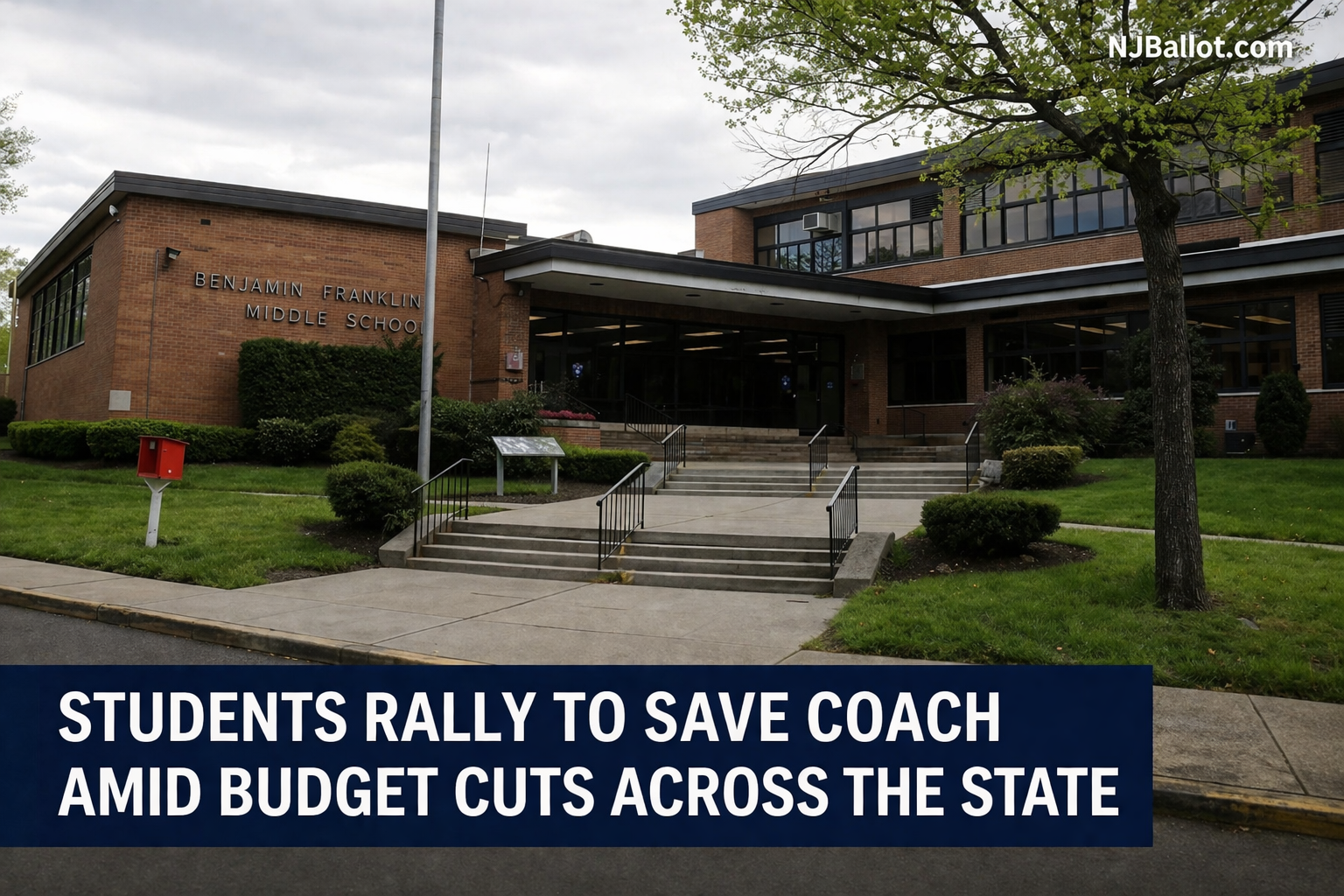
RIDGEWOOD —When Matteos Meschian learned his wrestling coach faced layoff, the Ridgewood High School student launched a petition. By Monday night, news reports indicate more than 900 people had signed "Keep Coach Franklin at Ridgewood," trying to save a physical education teacher at Benjamin Franklin Middle School they describe as "an invaluable pillar" of the community.
The coach's potential elimination is one piece of a $2.4 million deficit forcing the Ridgewood Public Schools Board of Education to cut 15 staff positions, eliminate bus routes, and raise property taxes 4 percent, approximately $528 annually for the average assessed home. The tax hike represents a historically high increase for the affluent Bergen County district, which had avoided such measures through prior economic downturns.
Superintendent Marc Schwarz acknowledged at a March 18 board meeting that layoffs could increase class sizes, though the district aims to cap sections at 30 students. The district spokesperson responded Monday with carefully worded ambiguity: "The district is taking their examples under consideration as it works to reduce positions without losing some of our valued staff members, like Coach Franklin."
The wrestling coach has become an unlikely symbol of a fiscal crisis extending far beyond Ridgewood's tree-lined streets.
The Statewide Pattern
Ridgewood is one of at least 11 New Jersey school districts simultaneously implementing austerity budgets for 2026-27, representing a structural crisis rather than isolated mismanagement. The pattern spans urban, suburban, and rural districts.
District
County
Deficit/Status
Key Cuts
Tax Increase
Cherry Hill
Camden
$14.5M deficit
Staff and program reductions
7.4% (~$420/yr)
Jersey City
Hudson
$100M deficit
200 positions at risk
TBD
Montclair
Essex
$19.6M deficit
100+ positions, 28 clubs eliminated
Split referendum result*
Hackensack
Bergen
$17M deficit
90 positions threatened
Prevented by city transfer
West Orange
Essex
$14–15M deficit
70+ positions, schedule restructuring
2.5% (~$294/yr)
Perth Amboy
Middlesex
$13M+ deficit
Prior-year busing cuts (August 2024)
TBD
Jefferson Twp
Morris
$4.8M deficit
Proposed athletics elimination
TBD
Haddonfield
Camden
Balanced budget†
5 paraprofessionals, elective reductions
5.95% (~$467/yr)
*Montclair referendum held March 10, 2026: Question 1 passed (one-time tax), Question 2 failed by 8 votes (permanent tax). District now relies on state aid advance; fiscal monitor appointment likely.
† Haddonfield maintains balanced budget through tax levy increase; no structural deficit.
The geographic diversity indicates this is not an Abbott district problem, nor limited to high-poverty or high-wealth municipalities. Districts with strong tax bases and those with limited capacity face simultaneous pressure.
Four Converging Pressures
The crisis stems from structural forces outside local control. A major factor lies in health insurance costs: Cherry Hill originally faced a 30 percent premium spike, though negotiations reduced the increase to 19.9 percent. But they still added approximately $10 million in costs. Districts statewide face similar volatility as post-pandemic utilization drives medical inflation.
Meanwhile pandemic-era federal funding has also begun to expire, cutting off another source of liquidity for schools. The Education Law Center noted in October 2025 that New Jersey faces "the loss of federal funding for public education" at levels unprecedented in this century. ESSER pandemic relief funds expired, removing flexible dollars that had backfilled operating budgets.
State law also plays a role. The 2018 School Funding Reform Act's six-year transition completed in FY2026, meaning that most school districts are funded according to the SFRA’s formula. While Governor Sherrill's proposed FY2027 budget maintains the 3 percent cut cap and 6 percent increase cap for state aid, districts including Jersey City and Cherry Hill continue to face reductions under the formula.
And even if districts had no choice but to raise taxes, New Jersey's 2 percent property tax levy cap, enacted in 2007, puts a democratic check on any proposal above the cap. The voter overrides provide one source of revenue but create political barriers. Ridgewood's 4 percent hike and Cherry Hill's 7.4 percent increase both required board votes and public notification.